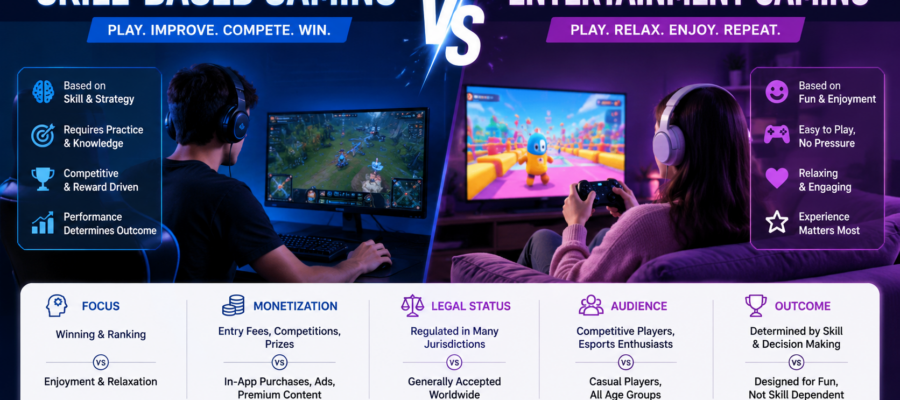
Skill-Based Gaming vs Entertainment Gaming
The gaming industry has evolved rapidly over the last decade, especially with the rise of mobile apps, esports, and real-money gaming platforms. Today, one of the most discussed topics is the difference between skill-based gaming and entertainment gaming. Although both fall under the broader category of gaming, they operate on very different principles, especially when it comes to user engagement, monetization, and legal classification.
This article breaks down both concepts in a simple, SEO-friendly way to help you clearly understand how they differ and why it matters in today’s digital gaming ecosystem.
What is Skill-Based Gaming?
Skill-based gaming refers to games where the outcome is primarily determined by a player’s knowledge, practice, strategy, and decision-making ability rather than luck.
In such games, the better you understand the mechanics and the more you practice, the higher your chances of winning. These games are often associated with competitive formats like esports or competitive real-money platforms.
Examples include:
- Fantasy sports platforms
- Poker (in skill-dominant jurisdictions)
- Chess-based online competitions
- Strategy-based mobile games
According to industry discussions on gaming classification, skill-based games are often separated from gambling because they involve measurable player input and mastery over time Funambulist Gaming Article.
What is Entertainment Gaming?
Entertainment gaming is designed primarily for fun, relaxation, and engagement, without any focus on monetary outcome or competitive advantage.
These games are typically casual and are not dependent on player skill for rewards or progression. Instead, they are built to provide immersive storytelling, visuals, and gameplay experience.
Common examples include:
- Single-player mobile games
- Arcade-style games
- Puzzle games with fixed outcomes
- Story-driven console games
Entertainment gaming focuses more on user experience and enjoyment rather than competition or financial rewards.
Key Differences Between Skill-Based and Entertainment Gaming
Although both categories may look similar on the surface, their core differences are significant.
1. Role of Skill vs Luck
Skill-based gaming relies heavily on the player’s ability, strategy, and decision-making. On the other hand, entertainment gaming often prioritizes fun mechanics where skill is not the determining factor for outcomes.
2. Purpose of Gameplay
Skill-based games are often competitive and sometimes involve rewards, rankings, or monetary incentives. Entertainment games are designed purely for enjoyment and relaxation.
3. Monetization Models
Skill-based platforms may use entry fees, competition-based winnings, or subscription models. Entertainment games typically rely on ads, in-app purchases, or premium game sales.
4. Legal Classification
One of the most important differences is legal recognition. Many jurisdictions differentiate between games of skill and games of chance, which affects regulation and taxation. Legal experts highlight that this distinction plays a major role in online gaming laws and compliance requirements Lawby26 Gaming Law Article.
Why This Distinction Matters in the Gaming Industry
The global gaming industry is now worth billions, and this classification is not just theoretical—it impacts real businesses.
Skill-based gaming platforms often operate in a legal gray area depending on the country. In contrast, entertainment gaming is widely accepted globally because it does not involve financial risk.
Additionally, developers are increasingly blending both models to create hybrid experiences where entertainment meets competition. This is especially visible in mobile gaming ecosystems.
Industry analysis shows that skill-based mechanics are increasingly being integrated into modern game design to improve user retention and engagement EJAW Gaming Insights.
Growth of Online Gaming and Hybrid Models
With the rise of the online gaming industry, boundaries between skill-based and entertainment gaming are becoming blurred. Developers now focus on:
- Competitive leaderboards
- Reward-based engagement systems
- Real-time multiplayer challenges
- Gamification of casual experiences
This hybrid approach ensures higher user engagement while maintaining accessibility for casual players.
You can read more about the broader concept of the gaming ecosystem here:
Online Gaming Overview (Wikipedia)
Legal and Ethical Considerations
One of the biggest challenges in this industry is regulation. Governments often struggle to classify whether a game is based on skill or chance. This classification directly affects whether the platform is treated as gaming or gambling.
For example:
- Skill-based games may require licensing in some regions.
- Games of chance may fall under gambling laws.
- Hybrid games may face stricter compliance requirements.
This is why companies in the iGaming industry invest heavily in legal compliance and transparency.
Learn more about the broader gaming regulation landscape here:
Game of Chance Concept (Wikipedia)
FAQs
1. Is skill-based gaming the same as gambling?
No. Skill-based gaming depends on player ability, while gambling is primarily based on chance.
2. Can entertainment games involve money?
Yes, but usually in the form of in-app purchases or cosmetic upgrades, not competitive winnings.
3. Why is skill-based gaming controversial?
Because in some jurisdictions, it is difficult to distinguish between skill and chance, leading to regulatory confusion.
4. Which is more popular today?
Entertainment gaming has a larger casual user base, but skill-based gaming is growing rapidly due to esports and competitive platforms.
5. Are all online games regulated?
No, regulation depends on the country, game type, and whether real money is involved.
Final Thought
The difference between skill-based gaming and entertainment gaming is becoming more important as the digital gaming world continues to expand. While entertainment gaming focuses on relaxation and storytelling, skill-based gaming emphasizes competition, strategy, and player ability.
As technology evolves, the line between these two categories will continue to blur, creating new opportunities for developers and players alike. However, understanding their core differences remains essential for users, regulators, and businesses operating in the global gaming ecosystem.