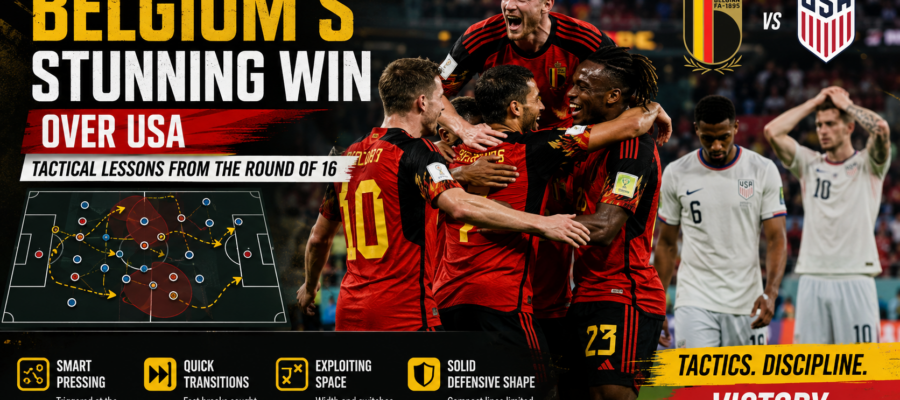
Belgium’s Stunning Win over USA: Tactical Lessons from the Round of 16
Knockout football is often decided by small tactical details rather than individual brilliance alone. Belgium’s victory over the United States in the FIFA World Cup Round of 16 was a perfect example of how disciplined positioning, intelligent pressing, and smart in-game adjustments can completely change the direction of a match. While the USA showed plenty of energy and commitment, Belgium demonstrated why tactical flexibility is one of the most valuable qualities in tournament football.
The contest was filled with momentum swings, but Belgium’s ability to exploit spaces and adapt their shape ultimately proved decisive. Beyond the final score line, this match offered several valuable tactical lessons for coaches, analysts, and football fans alike.
Belgium’s Tactical Flexibility Made the Difference
One of Belgium’s biggest strengths throughout the match was their willingness to adjust their shape depending on the phase of play.
Instead of remaining rigid, Belgium smoothly transitioned between defensive organization and attacking movement. Their midfield frequently shifted positions to create overloads in central areas while the wide players stretched the American defensive line.
Whenever the USA attempted to build from the back, Belgium responded with coordinated pressing rather than reckless pressure. This forced hurried passes and prevented the Americans from controlling possession for long periods.
Their tactical discipline ensured that every player understood both defensive and attacking responsibilities.
Exploiting Weaknesses in the USA’s Defensive Structure
The United States entered the match with an aggressive tactical approach, hoping to control midfield through numerical superiority.
However, Belgium identified several weaknesses.
The biggest issue came from the spaces that appeared behind the American wing-backs whenever possession was lost. Belgium consistently attacked these channels with quick switches of play and overlapping runs.
Instead of forcing attacks through the crowded middle, Belgium patiently waited for the right moments before accelerating down the flanks.
This intelligent use of width stretched the American defence and created better-quality scoring opportunities.
Intelligent Midfield Control
Belgium’s midfield deserves enormous credit for controlling the rhythm of the match.
Rather than chasing possession for its own sake, Belgian midfielders focused on controlling space.
Whenever the USA attempted vertical passes, Belgium’s midfield remained compact enough to intercept or force backward movement.
Their positioning also helped reduce the influence of America’s attacking midfielders, making it difficult for the USA to create clear chances through central combinations.
This balance between aggression and patience became one of Belgium’s biggest tactical advantages.
Effective Pressing without Losing Defensive Shape
High pressing has become common in modern football, but Belgium showed that pressing only works when every player moves together.
Instead of pressing individually, Belgium triggered pressure in carefully selected moments:
- Poor first touches by American defenders
- Backward passes near the defensive third
- Isolated full-backs receiving under pressure
- Slow ball circulation across the back line
These pressing triggers forced turnovers without exposing Belgium’s own defensive structure.
Even when the USA escaped the initial press, Belgium quickly regrouped into a compact defensive block.
This discipline limited counter-attacking opportunities.
Quick Transitions Changed the Game
Perhaps the most impressive aspect of Belgium’s performance was the speed of their transitions.
After winning possession, Belgium wasted very little time before attacking.
Instead of making unnecessary sideways passes, players immediately looked forward.
This direct style repeatedly caught the USA before their defensive shape could recover.
Fast transitions also reduced the effectiveness of the American midfield press because Belgium often bypassed multiple players with a single progressive pass.
Tournament football frequently rewards teams that transition efficiently, and Belgium demonstrated exactly why.
USA Showed Promise but Missed Key Tactical Adjustments
The United States should not be judged solely by the result.
They displayed impressive work rate, pressing intensity, and attacking ambition throughout large portions of the game.
However, several tactical issues became increasingly obvious:
- Large spaces behind advancing wing-backs
- Difficulty defending quick switches of play
- Midfield becoming stretched during transitions
- Limited creativity once Belgium compressed central areas
The Americans continued fighting until the final whistle, but Belgium consistently found solutions to every tactical challenge.
Future tournaments will likely see the USA improve these areas through greater tactical flexibility.
Individual Quality Supported the Tactical Plan
While tactics played a huge role, Belgium also benefited from intelligent individual performances.
Players consistently made unselfish off-ball runs that opened passing lanes for teammates.
Defenders remained calm under pressure and rarely forced risky passes.
Midfielders balanced defensive duties with progressive ball movement, while attackers constantly rotated positions to confuse American defenders.
Rather than relying on one superstar, Belgium succeeded because every player contributed to the overall tactical system.
That collective understanding made their game plan extremely effective.
Key Tactical Lessons From Belgium’s Victory
Several important football lessons emerged from this Round of 16 encounter:
- Tactical flexibility often matters more than possession.
- Compact defensive organization limits dangerous counter-attacks.
- Fast transitions create opportunities before defenses recover.
- Intelligent pressing is more effective than constant pressing.
- Width can stretch organized defensive blocks.
- Team coordination is usually stronger than individual brilliance.
These principles continue to define successful international teams competing at the highest level.
What This Result Means Going Forward
Belgium’s performance reinforced their reputation as one of international football’s most tactically intelligent teams.
The victory demonstrated that tournament football rewards discipline, adaptability, and collective decision-making rather than attacking flair alone.
For the USA, the defeat provides valuable learning opportunities.
Young squads often gain significant experience from facing elite tactical opponents, and those lessons can contribute to future success on the international stage.
As football continues evolving, tactical awareness will remain just as important as technical ability.
FAQs
Why was Belgium tactically superior against the USA?
Belgium controlled space effectively, pressed intelligently, transitioned quickly after winning possession, and exploited weaknesses behind the American wing-backs.
What was the biggest tactical mistake made by the USA?
The USA left too much space behind their wide defenders during attacking phases, allowing Belgium to launch dangerous counter-attacks through the flanks.
How important were Belgium’s transitions?
Very important. Belgium converted defensive recoveries into attacking opportunities within seconds, preventing the USA from reorganizing defensively.
Did Belgium rely only on individual talent?
No. Individual performances were excellent, but Belgium’s success primarily came from collective tactical discipline and coordinated team movement.
What can other teams learn from Belgium’s performance?
Teams can learn the importance of compact defending, structured pressing, intelligent positioning, quick transitions, and adapting tactics based on the opponent.
Final Thought
Belgium’s victory over the USA was far more than a knockout-stage win—it was a showcase of modern tactical football. Every phase of the game reflected careful planning, disciplined execution, and smart decision-making under pressure. While the United States displayed determination and attacking intent, Belgium consistently found solutions through superior positioning, coordinated pressing, and rapid transitions.
For coaches, players, and football enthusiasts, this match serves as an excellent reminder that success at the highest level is rarely achieved through talent alone. Tactical awareness, teamwork, and adaptability remain the foundations of championship-caliber performances. As future international tournaments unfold, the lessons from Belgium’s impressive Round of 16 display will continue to influence how elite teams approach knockout football.