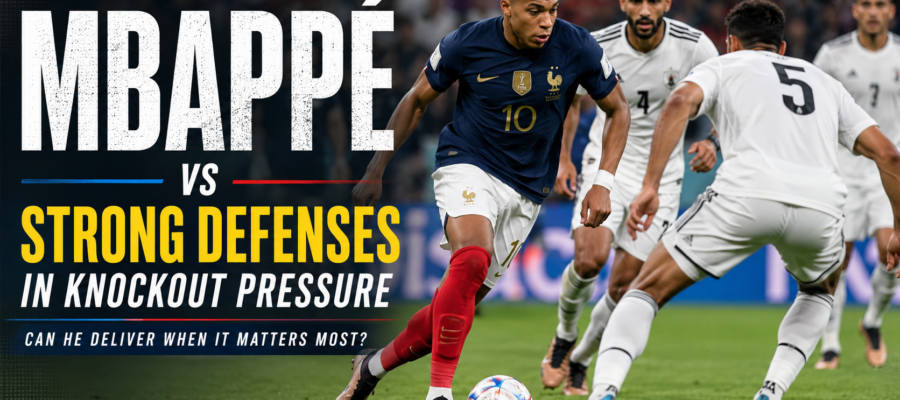
Mbappé vs Strong Defenses in Knockout Pressure: Can France’s Star Deliver When It Matters Most?
The FIFA World Cup is where football legends are made. Group-stage brilliance can capture headlines, but knockout football is where true greatness is measured. As France move into the knockout rounds of the FIFA World Cup 2026, all eyes are once again on Kylian Mbappé.
The French captain has already made a powerful statement in the tournament. His recent brace against Iraq helped France secure a comfortable 3-0 victory despite a lengthy weather delay in Philadelphia. The performance not only sent France into the knockout stage but also reinforced Mbappé’s reputation as one of the most dangerous attackers in world football. Recent reports highlighted how he controlled the game, scored twice, and continued his remarkable World Cup scoring record.
However, a bigger question now emerges: How effective is Mbappé when facing elite defenses under knockout pressure?
Why Knockout Matches Are Different
Group-stage football and knockout football are two completely different challenges.
During the group stage, teams often take more risks because there are multiple opportunities to recover from mistakes. In knockout matches, every error can end a nation’s dream. Defensive lines become tighter, midfield spaces disappear, and opponents build entire game plans around stopping one player.
For France, that player is Mbappé.
Opposing managers understand that limiting his space significantly reduces France’s attacking threat. As a result, strong defensive teams often use double-marking systems, compact defensive blocks, and quick defensive transitions specifically to neutralize him.
This is where the real test begins.
Mbappé’s Record in High-Pressure Matches
One reason why France remain among the tournament favorites is Mbappé’s proven ability to perform on the biggest stage.
Since making his World Cup debut, he has consistently delivered in crucial moments. His performances in previous World Cups established him as one of the most productive knockout-stage attackers of his generation. His current World Cup tally has already placed him among the tournament’s greatest goalscorers.
What separates Mbappé from many elite forwards is his ability to create chances even when defensive teams dominate possession or sit deep. His acceleration, movement behind defenders, and clinical finishing make him dangerous even when receiving limited service.
Football analysts regularly point to his pace and ability to attack open spaces as game-changing qualities, especially during knockout football where a single transition can decide an entire match.
How Strong Defenses Try to Stop Him
Elite defensive teams usually follow a similar blueprint against Mbappé.
1. Limiting Space Behind the Back Line
Mbappé thrives when defenders leave gaps behind them. Strong defensive teams often maintain a deeper defensive line to prevent his explosive runs.
2. Double-Team Pressure
Many opponents assign a full-back and a covering midfielder to track his movement. This reduces his opportunities to isolate defenders in one-on-one situations.
3. Forcing Him Wide
Rather than allowing Mbappé to attack central areas, defenders attempt to push him toward the sidelines where scoring opportunities become less dangerous.
4. Physical Midfield Control
Strong defenses often begin with midfield dominance. By disrupting France’s passing rhythm, opponents can reduce the quality of service reaching Mbappé.
Why France Still Have an Advantage
The challenge for opponents is that France are no longer a one-man team.
Players like Ousmane Dembélé, Michael Olise, and France’s creative midfield provide additional attacking options. Against Iraq, Dembélé scored while Olise contributed important assists, showing that opponents cannot focus exclusively on Mbappé.
This supporting cast creates a tactical dilemma.
If defenders overload Mbappé’s side, other French attackers gain space. If they spread their defensive attention evenly, Mbappé becomes far more dangerous.
France’s attacking depth has become one of their biggest strengths throughout the tournament. Several analysts believe this offensive firepower can compensate for occasional defensive vulnerabilities.
The Mental Side of Knockout Football
Talent alone does not win knockout matches.
Mental resilience often determines success. The pressure increases dramatically with every round, and expectations on star players become enormous.
Mbappé has spent years carrying these expectations. Whether playing for club or country, he regularly enters major tournaments as the player opponents fear most.
Recent discussions among football analysts and fans have highlighted how he continues to embrace leadership responsibilities while handling intense scrutiny. His response on the field has been impressive, with goals, assists, and decisive performances arriving when France need them most.
This experience could prove invaluable as the knockout rounds progress.
Key Factor: Can Mbappé Beat Organized Defenses?
The biggest challenge ahead is not whether Mbappé can score goals.
The question is whether he can consistently break down highly organized defensive units that spend weeks preparing specifically for him.
History suggests he can.
His combination of pace, movement, finishing ability, and big-game experience makes him one of the few players capable of producing decisive moments from seemingly impossible situations.
Even when strong defenses succeed in limiting his influence for long periods, Mbappé often requires only one opportunity to change a match.
That quality separates world-class players from football legends.
Frequently Asked Questions
Has Kylian Mbappé helped France qualify for the World Cup 2026 knockout stage?
Yes. Mbappé scored twice against Iraq as France secured a 3-0 victory and advanced to the knockout rounds.
Why are knockout matches harder for attackers?
Knockout games feature more organized defensive structures, fewer risks from opponents, and significantly higher pressure compared to group-stage matches.
What makes Mbappé dangerous against strong defenses?
His pace, movement, finishing ability, and capacity to exploit small defensive mistakes make him effective even against elite opponents.
Can France win the FIFA World Cup 2026?
France are considered among the strongest contenders due to their attacking depth, tournament experience, and the presence of players like Mbappé.
What is Mbappé’s biggest challenge in the knockout stage?
Breaking down compact and highly organized defensive systems that are specifically designed to limit his impact.
Final Thoughts
Kylian Mbappé has already demonstrated why he remains one of football’s most feared players. His performances during the group stage have been exceptional, but the real examination starts now.
Knockout football is unforgiving. Strong defenses will attempt to close every space, disrupt every run, and frustrate France’s captain at every opportunity.
Yet history has shown that the biggest stages often bring out the best in Mbappé. If France are to lift another World Cup trophy, their superstar forward will likely need to produce more moments of brilliance against the toughest defensive opponents remaining in the tournament.
The pressure is enormous. The challenge is difficult. But these are exactly the moments where legends are created.