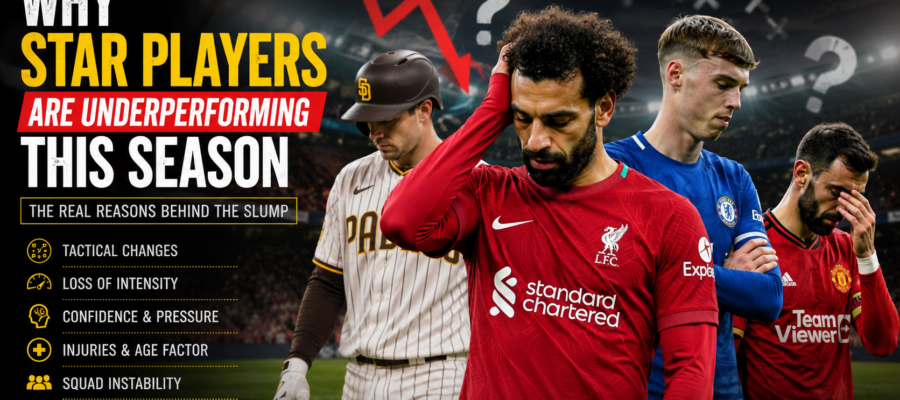
Why Some Star Players Are Underperforming This Season: A Complete Analysis
Every season in professional sports brings a familiar surprise: elite, world-class players suddenly look average or inconsistent. Whether it’s MLB veterans struggling with form or football stars at clubs like Liverpool and Chelsea failing to deliver expected results, the pattern raises an important question—why do top players underperform even when their talent hasn’t changed?
Using insights from MLB performance breakdowns, Liverpool’s tactical issues, and Chelsea fan discussions, this article explains the real reasons behind this trend in a clear, structured way.
Ageing Curve and Natural Physical Decline
Even the best athletes in the world cannot escape time. One of the biggest reasons for underperformance is the natural ageing curve.
In baseball, veteran players often experience subtle declines in bat speed, reaction time, and timing consistency. These changes are not always visible in highlights, but they significantly impact performance at the elite level. Even a 2–3% drop in reaction time can reduce batting efficiency dramatically.
This is why experienced MLB stars sometimes struggle despite appearing physically fit—they are still strong, but their micro-timing and explosiveness decline slightly, which affects results over a long season.
Tactical System Changes and Role Misalignment
A major factor in football underperformance is system mismatch.
For example, Liverpool’s struggles have been linked to changes in playing style and reduced attacking fluidity. Reports suggest that the team has lost some of its intensity and structured attacking patterns, which previously helped forwards perform at a high level (sports.yahoo.com).
When systems change:
- Players receive fewer quality chances
- Roles become less defined
- Movement patterns lose synchronization
- Confidence in decision-making drops
Even top players struggle when their tactical environment no longer suits their strengths.
Drop in Team Intensity and Collective Performance
Individual brilliance depends heavily on team structure.
Analysis of Liverpool’s season highlights a clear drop in pressing intensity and overall match control, which directly affects attacking output (skysports.com).
When team intensity drops:
- Star players get fewer attacking transitions
- Defensive pressure increases mistakes
- Space becomes harder to find
- Rhythm of play breaks down
Even the best players look ineffective when the team around them fails to maintain high standards.
Psychological Pressure and Confidence Slumps
Mental pressure plays a huge role in elite sports performance.
Once a star player enters a short scoring drought or performance dip:
- They start overthinking decisions
- Confidence reduces in key moments
- Risk-taking becomes inconsistent
- Media and fan pressure increases stress
Reddit discussions around Chelsea players highlight how quickly public criticism can amplify performance issues, turning a small slump into a long-term confidence problem.
At elite level, confidence is as important as fitness.
Squad Instability and Lack of Chemistry
Frequent squad changes or tactical rebuilds can disrupt even the best teams.
Liverpool’s inconsistent performances have been partially linked to squad transitions and evolving tactical systems, which affect rhythm and chemistry between players (sportsmole.co.uk).
When teams lack stability:
- Passing combinations weaken
- Timing between players becomes inconsistent
- Understanding of movement patterns declines
- Decision-making slows down
Star players rely heavily on coordination with teammates, and instability breaks that flow.
6. Statistical Variance and Short-Term Form Dips
Not every underperformance is structural—sometimes it is just normal variance.
In MLB, even players with strong underlying metrics can go through periods of poor results due to timing issues or bad luck. A slight change in contact angle or pitch timing can drastically reduce batting averages over short stretches.
Similarly in football:
- Strikers miss chances they normally convert
- Goalkeepers face higher-quality shots unexpectedly
- Deflections and margins go against teams
These fluctuations are part of sports and often correct themselves over time.
Opponent Adaptation and Targeted Defending
As players become stars, opponents adapt specifically to stop them.
This includes:
- Double marking key attackers
- Cutting passing supply lines
- Forcing weaker teammates to take responsibility
- Blocking preferred movement zones
The more successful a player becomes, the more tactical attention they receive. This makes maintaining consistent output significantly harder.
FAQs
Q1. Why do star players suddenly lose form?
Star players usually don’t “suddenly decline.” Their drop in form is often due to a mix of tactical changes, reduced confidence, stronger opposition focus, or minor physical decline.
Q2. Is ageing the main reason for underperformance?
Ageing is a major factor in some cases (especially veterans), but it is rarely the only reason. Tactical systems and team structure are equally important.
Q3. Can a player recover from a slump?
Yes. Most slumps are temporary. Once confidence returns and tactical rhythm improves, performance often rebounds within a few matches or weeks.
Q4. Why do fans notice underperformance more today?
Modern analytics, social media, and constant coverage make dips in performance more visible than ever before. Small issues are quickly amplified.
Q5. Do team tactics affect star players that much?
Absolutely. Even elite players depend heavily on system support. Without proper structure, their output can drop significantly.
Final Thought
Underperformance in star players is rarely about talent loss. More often, it is a combination of system mismatch, psychological pressure, tactical changes, and normal performance variance.
Modern sports are not just about individual brilliance anymore—they are about how well a system supports that brilliance. When the environment weakens, even the best players in the world can look ordinary.
The key takeaway is simple: stars don’t always fall in form—sometimes the system around them stops lifting them up.